
Knee
The most heavily used joint: sport, stairs, prolonged sitting. The cut wraps the kneecap and stays in place during movement.
Cryopad for cold, Thermopad for heat. The same technology fits many body zones and comes in four fields of use, from returning home after surgery to recovery between two training sessions.
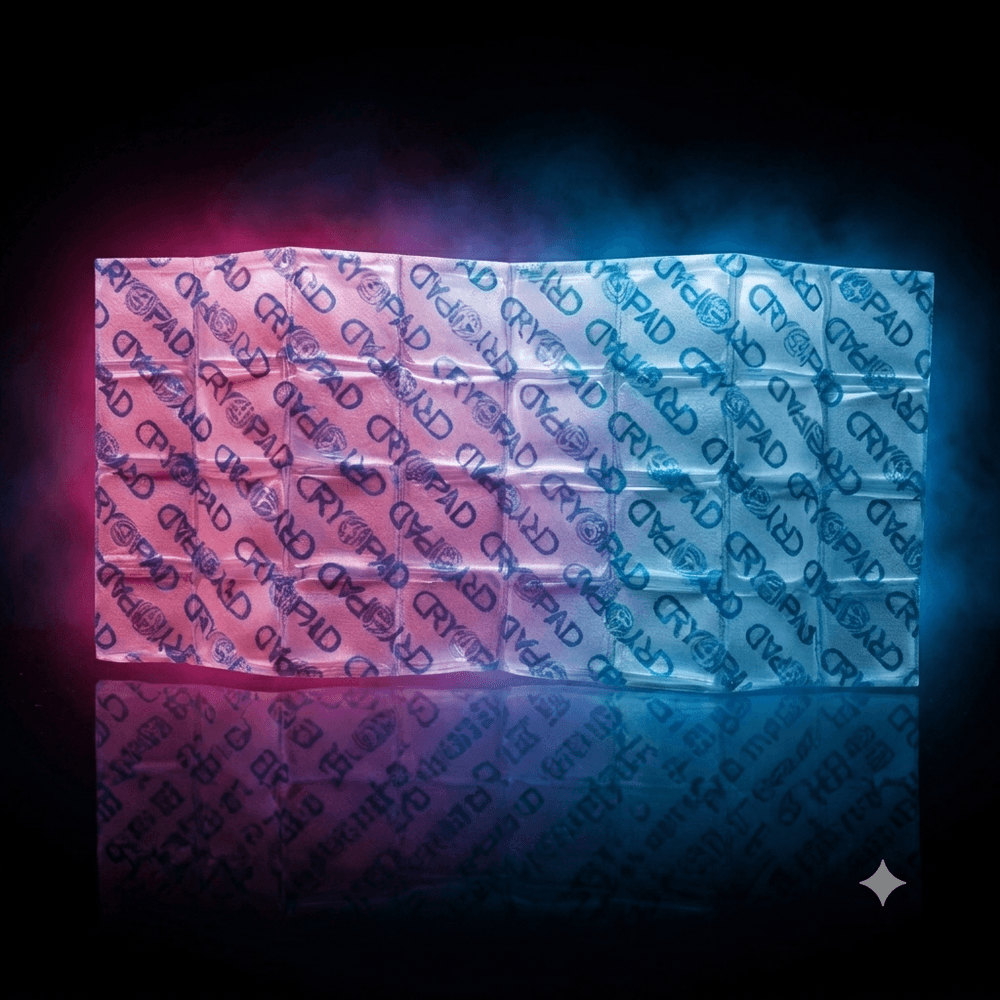
Cryopad (cold) and Thermopad (heat) technology covers the whole body, from head to toe (head, neck, face, shoulder, hands, wrist, back and lower back, hip, knee, leg, ankle, breast area) across four fields of use: orthopaedic post-operative care, sports recovery, aesthetic surgery, medical and rehabilitation. Every zone comes in a cold version and a heat version, to be integrated into a brace or a garment.
The same technology meets very different needs depending on the context. Here is how cold and heat fit into each one.
After surgery on the shoulder, hip, knee or ankle, cold supports the acute phase; heat can take over afterwards. The zone-specific cut and the support under the brace ensure constant contact. Typical zones: shoulder, hip, knee, ankle.
Cold after exercise, on a warmed-up zone; heat to release a contracture or prepare a return to movement. A mobile, reusable thermal response, suited to training as well as competition. Typical zones: knee, leg, ankle, back.
Post-operatively, cold contributes to comfort on sensitive areas such as the face or chest. Dedicated formats ensure soft, even contact. Typical zones: face, breast.
Thermopad heat supports contractures, cramps and muscle stiffness, alongside a rehabilitation protocol. Gentle, sustained heat, with no hot spot. Typical zones: back and lower back, leg, shoulder.
These use examples are provided for guidance only and do not replace medical advice. Indications depend on each situation and on the healthcare professional.
From head to toe, almost every part of the body can be addressed. Each zone has its own cut, designed to follow the anatomy and stay in close contact under the brace or garment. The same pad comes in cold (Cryopad) and heat (Thermopad). Blue dot, cold; amber dot, heat.
The most heavily used joint: sport, stairs, prolonged sitting. The cut wraps the kneecap and stays in place during movement.
An enveloping shape that follows the deltoid, without slipping.
A curved cut for the trochanteric area.
The largest format in the range: thigh, calf or the whole leg, for a continuous contact surface along the full length.
A shape designed to wrap around the malleolus.
A wide surface for the lower back.
Compact, for a fine and mobile joint.
A flexible format for the skull and forehead, migraines or post-procedure recovery.
An enveloping cut for the nape, cervical tension and stiffness.
Soft, even contact, post-operative comfort in aesthetic surgery.
Small formats for the wrist, hand and fine joints.
A dedicated format, designed for soft, even contact on the chest, on sensitive areas after a procedure.
The technology is designed to integrate into a brace or a support device: the pad delivers the right temperature, the brace ensures constant contact on the zone. It is this combination that our partners integrate into their products.
Integrate Cryopad and Thermopad into your braces, for the zone and the use case of your market.
Tell us about your market and the type of brace involved. The EasyCryo team studies how the technology can be integrated.